As an investor it is quite important to realize how reliable our methods or indicators are. If we don’t know the limitations of our tools, then how are we going to use them well? Some readers may be surprised to know that I have never more than 60% confidence in any of my methods, cycles, indicators or forecasts. I expect them to be wrong at least 40% of the time. And I never have more than 60% confidence in methods, indicators or analysis I find elsewhere on the internet or in books, no matter how compelling the evidence that is being presented. That’s what I call the 60% rule. More on that and on its implications for trading further down in this post.
Let’s start with our customary look at the S&P 500 index (click for larger image):
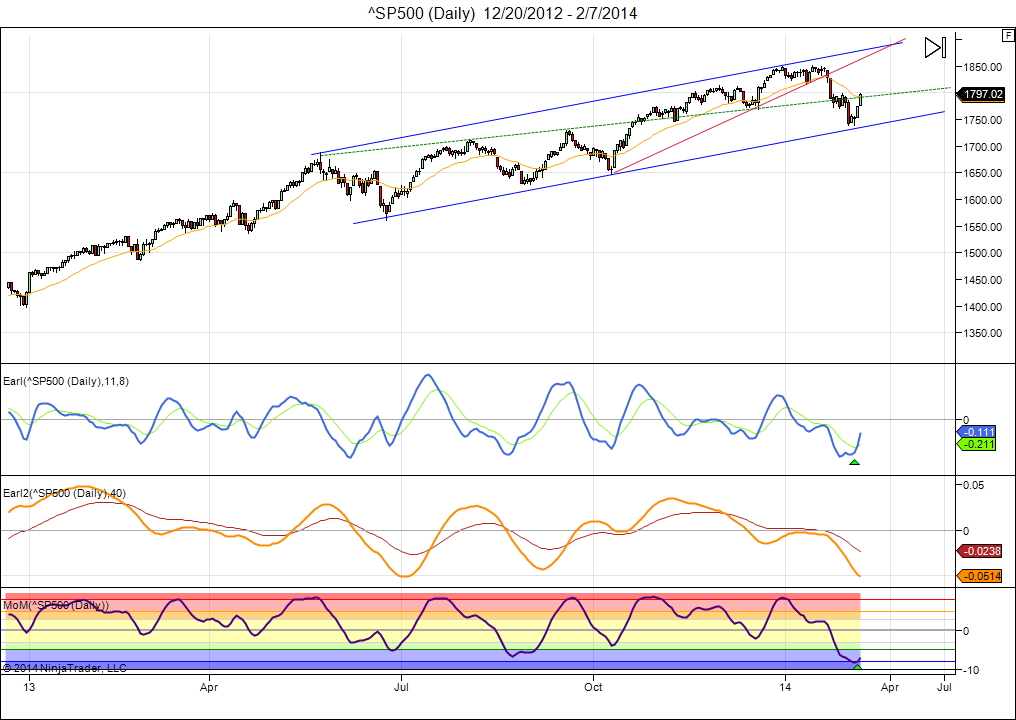
Last week’s drop saw the market test important support near 1750 before rebounding. We have another week of lunar red period to go, so it’s quite possible that the lows get tested again this week. But several of my indicators now show a nice bottom. The MoM indicator has actually dropped to its lowest levels since May 2012.
So, I think the recent lows will hold and then we will probably see the market climb back until March or April. Sentiment has become especially negative for emerging markets, but my weekly key reversal system is starting to give long term buy signals for markets like Indonesia and Vietnam. Of course, we cannot be more than 60% confident in any of the above.
Why this 60% rule? Well, if we are lucky enough to find some edge in the market it will always be a small edge. There are no big edges to be found in liquid markets. If we find something that works 60% of the time we can do very well already. But our game plan will need to take into account that we will be wrong 40% of the time. Peter Lynch, the famous investor, formulated it like this:
“In this business, if you’re good, you’re right 6 times out of 10. You’re never going to be right 9 times out of 10.”
The advantage of knowing that you will be right only 6 times out of 10 is that you start with realistic expectations and will not suffer from overconfidence. It also comes easier to cut losses short when you know that you will be wrong 4 times out of 10.
So, I always aim for 60% accuracy with my methods and in my forecasting. And that’s hard enough to do. For example, we expect markets to be stronger in lunar green periods than in lunar red periods. How reliable is it? Comparing the green periods to the red periods that come immediately before and after, is a simple way to remove effects from longer term trend and offers a fair comparison. Since 2009, when we started this blog, the green periods have outperformed the red periods that come before and after it 57.5% of the time. So, quite close to 60%.
Good luck,
Danny
Related articles


 LunaticTrader Blog
There was a time I felt glorious that I assumed my sure-win method was found, untile I failed thoroughly…
That’s the learning journey of every trader. Overconfidence is a very expensive hobby in the markets. It’s better to think more like tennis players. If you can win 52% of the points you will already have good chances of winning the match.
Why is 52%?
Tennis is not completely similar to trading. But if you watch match statistics from the coming Australian Open (or any other grand slam), you will see that the player who wins 52% of the points will almost aways win the match. It’s good to think in the same fashion when it comes to trading well. We only need a good enough batting average. That’s why focusing on winning every trade ( as some beginners tend to do) is the wrong approach. The 60% rule is the same concept, expect to have a good deal of losses to cut regularly, just like you would expect to lose about half of the points against an equal level opponent in tennis. This will not always be 52% or 60% when it comes to trading. It depends on the strategy. E.g. there are trading strategies that have only 30% winning trades, but because the average win is much bigger than the average loss it can still be very profitable.
I got what you mean! Thank you! It is talking about the balance between return rate and win rate.